Thursday, February 8, 2018
New Website
I haven't posted in a while. Ok, a long while. But I've been busy transitioning back into photography. Mostly fine art photography. That doesn't mean I'm not going to write anymore. I'm sure I'll incorporate writing into my new work in some way, and I have no doubt some story will attempt to claw its way out of my skin at some point, but if you're interested in checking out what I've been up to lately, check out davidglenlarson.com

Monday, April 10, 2017
CONCUSSION
I was just listening to an old audio story I wrote for the fabulous Escape Pod, and thought I'd put it up again. There are a couple technical changes I would've made to the story (a couple mistakes you might not pick up on unless you really know football), but overall I love the production value and the story was a fun bit of science fiction. Give Concussion a listen.
Thursday, August 11, 2016
10 Screenwriting Tips From Billy Wilder

1: The audience is fickle.
2: Grab ’em by the throat and never let ’em go.
3: Develop a clean line of action for your leading character.
4: Know where you’re going.
5: The more subtle and elegant you are in hiding your plot points, the better you are as a writer.
6: If you have a problem with the third act, the real problem is in the first act.
7: A tip from Lubitsch: Let the audience add up two plus two. They’ll love you forever.
8: In doing voice-overs, be careful not to describe what the audience already sees. Add to what they’re seeing.
9: The event that occurs at the second act curtain triggers the end of the movie.
10: The third act must build, build, build in tempo and action until the last event, and then — that’s it. Don’t hang around.
Saturday, April 9, 2016
SFWA Cookbook

A reminder that the SFWA's 50th Anniversary Ad Astra Cookbook is still available. I'm not sure about the print version, but you can order the kindle version from Amazon. It's a great cookbook with recipes from some of your favorite authors, me included, and all proceeds go to the SFWA legal fund.
50th Anniversary SFWA Cookbook
- 157 dishes & how-tos
- 134 contributors
- So. Much. Coffee
- Multiple Grand Masters
- Hugo, Nebula, & Locus award-winners
- Agents, editors, artists
- Several badgers
Friday, April 8, 2016
Fluff Piece
It's not that I avoid writing. I'm really only right in the head when I am writing. But there are times when things need to marinate in the mind, or ferment until they're ready to intoxicate. So other than making spoons, another thing I love doing is making marshmallows.
There's nothing quite like a pillowy cloud of marshmallow deflating in your mouth, its flavor spreading across your tongue like sunshine on a window sill. Overselling? Perhaps a bit. But they need hype.
When most people think of Marshmallows they think of the ubiquitous bags at the bottom of the baking aisle, good for charring at the bottom of a campfire, or maybe they of s'mores, or that whipped stuff that comes in a jar.
But if this is the only marshmallow you know, you've never tried homemade marshmallows. The great thing about making them yourself is you control what ingredients, so there's no need for chemicals you can't pronounce. The most exotic chemical I've included is citric acid. And booze of course. Bourbon, rhubarb bitters, limoncello, etc.
The best recipe I've tried is this one from Epicurious: Lemon Marshmallows. They're bright and tangy and delicious. A drop or two of Fee's rhubarb bitters adds something a little extra special, just don't give those to kids. My last batch of marshmallows was tangerine, basically using the Epicurious recipe, but substituting tangerine (Mandarine orange). They were good, but subtle. A little too subtle.
I have no doubt orange-cream would be delicious, and I'd love to try a blueberry-lemonade. I think I'll need freeze dried blueberry powder for that one. Fresh blueberry is too mild. By the way, if you haven't tried the combination, blueberry and lemon is magical, and not just because my favorite color combination is yellow and blue.
All right, I've made the case for marshmallows. Being the trendsetter I am, no doubt they'll be the new cupcake or macaron. It's back to editing for me. But maybe just one more tangerine marshmallow before I do.


There's nothing quite like a pillowy cloud of marshmallow deflating in your mouth, its flavor spreading across your tongue like sunshine on a window sill. Overselling? Perhaps a bit. But they need hype.
When most people think of Marshmallows they think of the ubiquitous bags at the bottom of the baking aisle, good for charring at the bottom of a campfire, or maybe they of s'mores, or that whipped stuff that comes in a jar.
But if this is the only marshmallow you know, you've never tried homemade marshmallows. The great thing about making them yourself is you control what ingredients, so there's no need for chemicals you can't pronounce. The most exotic chemical I've included is citric acid. And booze of course. Bourbon, rhubarb bitters, limoncello, etc.
The best recipe I've tried is this one from Epicurious: Lemon Marshmallows. They're bright and tangy and delicious. A drop or two of Fee's rhubarb bitters adds something a little extra special, just don't give those to kids. My last batch of marshmallows was tangerine, basically using the Epicurious recipe, but substituting tangerine (Mandarine orange). They were good, but subtle. A little too subtle.
I have no doubt orange-cream would be delicious, and I'd love to try a blueberry-lemonade. I think I'll need freeze dried blueberry powder for that one. Fresh blueberry is too mild. By the way, if you haven't tried the combination, blueberry and lemon is magical, and not just because my favorite color combination is yellow and blue.
All right, I've made the case for marshmallows. Being the trendsetter I am, no doubt they'll be the new cupcake or macaron. It's back to editing for me. But maybe just one more tangerine marshmallow before I do.


Thursday, April 7, 2016
Spoons
It's been ages since I posted anything here, so I thought I'd share random things I've been up to lately. El Niño recently toppled a diseased birch in the front yard, and after several days with a chainsaw, I thought it a shame that all that wood should go to waste. Sure, quite a bit of it had bin ravaged by the bronze borer beetle, but there were enough good logs to make me wish I had paid more attention in shop class back in middle school. But wishing is worthless, so I resolved to learn the art of carving.
But what would I carve? My drawing skills are rather sad, and so I had every reason to believe sculpting things meant to resemble other things would be a fruitless task. But a spoon I might be able to manage.
I ordered a lovely set of two Mora carving knives from Sweden and a cheap hatchet from the local hardware store, and over the course of a month I buried myself in wood shavings. I was quite surprised by how the first spoon turned out, and even more surprised by the second. By the end of March I'd created several pieces I'm quite proud of, and had only two failures. And they were complete failures—a tiny fork and a honey dipper. Lessons learned.
It's amazing how the hours can fly by when immersed in an activity like carving. The image of the old bearded man whittling away on the front porch makes so much sense to me now. It's a great stress reliever, and March was a stressful month. A tiny part of that stress was due to the editing process. I'd finished my novel, but the last two chapters didn't work. There was too much material, and it didn't feel cohesive with the rest. Bottom line I was good and stuck. But as I whittled, I realized how liberating it can be to remove, to carve away, to shave off all of the extra stuff covering what it is I wanted to see or reveal.
When you're carving a spoon, you start with a log, split it, then chop away everything but a flat, rectangular block of wood. On that blank canvas you draw a spoon, preferably using the grain as a guide to the most pleasing shape, and with a knife or two you simply cut away everything that isn't the spoon. Sometimes you cut too much, or you meet a knot you didn't expect, or even a poor bug that had made the wood its home, but you adapt and find the spoon that's there, even if it isn't exactly the spoon you thought was there.


But what would I carve? My drawing skills are rather sad, and so I had every reason to believe sculpting things meant to resemble other things would be a fruitless task. But a spoon I might be able to manage.
I ordered a lovely set of two Mora carving knives from Sweden and a cheap hatchet from the local hardware store, and over the course of a month I buried myself in wood shavings. I was quite surprised by how the first spoon turned out, and even more surprised by the second. By the end of March I'd created several pieces I'm quite proud of, and had only two failures. And they were complete failures—a tiny fork and a honey dipper. Lessons learned.
It's amazing how the hours can fly by when immersed in an activity like carving. The image of the old bearded man whittling away on the front porch makes so much sense to me now. It's a great stress reliever, and March was a stressful month. A tiny part of that stress was due to the editing process. I'd finished my novel, but the last two chapters didn't work. There was too much material, and it didn't feel cohesive with the rest. Bottom line I was good and stuck. But as I whittled, I realized how liberating it can be to remove, to carve away, to shave off all of the extra stuff covering what it is I wanted to see or reveal.
When you're carving a spoon, you start with a log, split it, then chop away everything but a flat, rectangular block of wood. On that blank canvas you draw a spoon, preferably using the grain as a guide to the most pleasing shape, and with a knife or two you simply cut away everything that isn't the spoon. Sometimes you cut too much, or you meet a knot you didn't expect, or even a poor bug that had made the wood its home, but you adapt and find the spoon that's there, even if it isn't exactly the spoon you thought was there.
 |
| a 10g coffee measuring cup in progress |

 |
| My first two spoons carved from the same half of a split log |
 |
| A birch santoku taking shape |

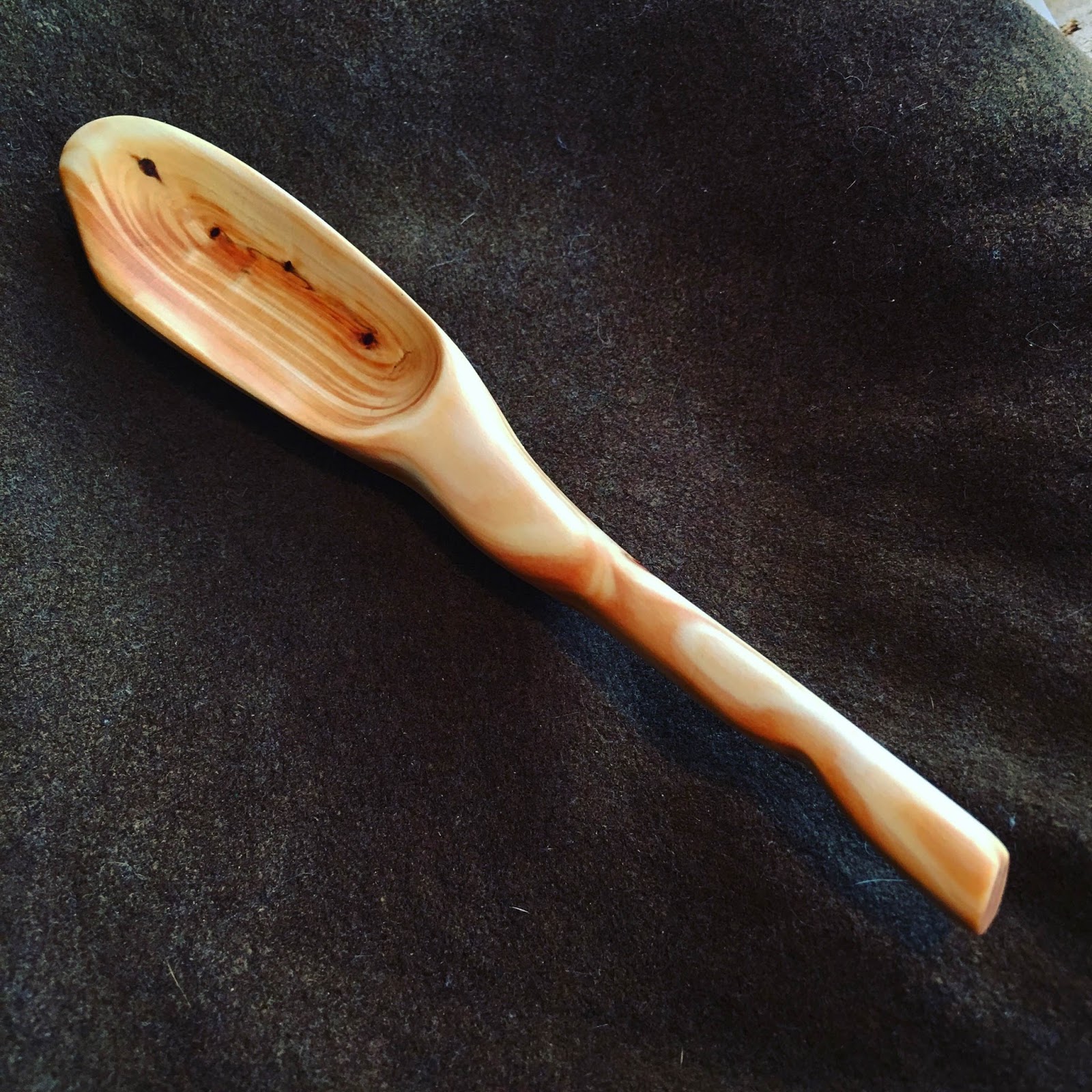 |
| following the curved grain in this small cypress spoon |
Tuesday, November 4, 2014
I AM
In the ocean of infinite emptiness,
before the birth of time,
a singular being was born
calling itself I Am.
Seeing that it was alone in the emptiness,
a universe of one,
I Am grew lonely,
And in its desire for companionship,
swelled and split in two,
becoming We Are.
Though they now had each other in the emptiness,
We Are were no longer whole,
and the void around them seeped inside,
filling their empty spaces.
Then they were just as lonely as when
We Are was I Am,
and so they swelled and split again,
this time into four,
and sixteen and so on,
each time yearning for satiety,
but with every division each was less whole than before,
and the emptiness continued to fill the cavities left behind.
Soon there was so much of the surrounding void in every I Am
it became impossible to distinguish them from it,
until what few fragments were left of their
I Amness dissolved away,
taking with it time,
before a singular being was born
calling itself I Am.
* * *
Originally published in Star*Line 35.1 (Jan-March 2012; Marge Simon editor)
This poem may not appear properly formatted on mobile devices
Wednesday, October 8, 2014
"Words Belong to Each Other"
Here's a gem from Brainpickings. Listen to Virginia Woolf ( in that amazing, long-vanished accent) talking about craft.
http://www.brainpickings.org/2013/04/29/craftsmanship-virginia-woolf-speaks-1937/
http://www.brainpickings.org/2013/04/29/craftsmanship-virginia-woolf-speaks-1937/
Friday, September 19, 2014
Friday, August 29, 2014
About Running After Ideas
You just say, "Well, hell, I don't need depression. I don't need worry. I don't need to push." The ideas will follow me. When they're off-guard, and ready to be born, I'll turn around and grab them.
Ray Bradbury, 1982, from Zen in the Art of Writing
Thursday, April 10, 2014
Word of the Day
Sensuist: One who delights in the senses.
Not to be confused with Sensualist, someone devoted to physical pleasure (esp. sexual), though there is certainly overlap.
Friday, January 17, 2014
Desert Places By Robert Frost
Desert Places
By Robert Frost
Snow falling and night falling fast, oh, fast
In a field I looked into going past,
And the ground almost covered smooth in snow,
But a few weeds and stubble showing last.
The woods around it have it - it is theirs.
All animals are smothered in their lairs.
I am too absent-spirited to count;
The loneliness includes me unawares.
And lonely as it is, that loneliness
Will be more lonely ere it will be less -
A blanker whiteness of benighted snow
WIth no expression, nothing to express.
They cannot scare me with their empty spaces
Between stars - on stars where no human race is.
I have it in me so much nearer home
To scare myself with my own desert places.
Bright Star By John Keats
Bright Star
By John Keats
Bright star, would I were stedfast as thou art—
Not in lone splendour hung aloft the night
And watching, with eternal lids apart,
Like nature's patient, sleepless Eremite,
The moving waters at their priestlike task
Of pure ablution round earth's human shores,
Or gazing on the new soft-fallen mask
Of snow upon the mountains and the moors—
No—yet still stedfast, still unchangeable,
Pillow'd upon my fair love's ripening breast,
To feel for ever its soft fall and swell,
Awake for ever in a sweet unrest,
Still, still to hear her tender-taken breath,
And so live ever—or else swoon to death.
A Dream Within a Dream by Edgar Allan Poe
A Dream Within a Dream
By Edgar Allan Poe
Take this kiss upon the brow!
And, in parting from you now,
Thus much let me avow —
You are not wrong, who deem
That my days have been a dream;
Yet if hope has flown away
In a night, or in a day,
In a vision, or in none,
Is it therefore the less gone?
All that we see or seem
Is but a dream within a dream.
I stand amid the roar
Of a surf-tormented shore,
And I hold within my hand
Grains of the golden sand —
How few! yet how they creep
Through my fingers to the deep,
While I weep — while I weep!
O God! Can I not grasp
Them with a tighter clasp?
O God! can I not save
One from the pitiless wave?
Is all that we see or seem
But a dream within a dream?
Saturday, January 11, 2014
Warming Up to Global Warming
Next time someone says "many (or most) scientists disagree about whether global warming is real, or that people have anything to do with it," you can show them this graph--

Then watch as they use it as "proof" that all scientists (save one intrepid soul who can't be bought) are part of a global conspiracy to bilk governments, downtrodden corporations, and sheeple out of research money just so these unscrupulous Ivy League tyrants can maintain their fleet of Bentleys and Lambos, as well as the lavish lifestyle to which their overly generous university salary entitles them.
They will go on to explain to you (in a very condescending, perhaps even paternal tone) that climate is cyclical, and if we're in such a warming trend, how come that damn ship got stuck in the ice, huh? They might even mention that Vikings lived on Greenland a thousand years ago when it was slightly warmer and well, greener, and were forced to leave when the climate grew too cold (according to Forbes anyway, though new research shows this to be the least significant reason they were forced to leave the island). Now Greenland is warming again, so see? Cyclical. Never mind that what once took centuries, even millennia, is now taking only decades, and that once the ice leaves it will never return, and the desertification of the planet will continue unabated.
All this scientific consensus means nothing, they might argue. After all, the scientific consensus once held that the Earth was flat. Only no, it was the consensus of the church, not the scientists.
After all this arguing, you might find your opponent doubling back in a rather odd way, making a statement such as this: "well even if it's true, there's nothing we can do about it because of China." And at that point you must admit defeat and simply shake your head, hoping the mud fish and cockroaches have a better go of it.
Then watch as they use it as "proof" that all scientists (save one intrepid soul who can't be bought) are part of a global conspiracy to bilk governments, downtrodden corporations, and sheeple out of research money just so these unscrupulous Ivy League tyrants can maintain their fleet of Bentleys and Lambos, as well as the lavish lifestyle to which their overly generous university salary entitles them.
They will go on to explain to you (in a very condescending, perhaps even paternal tone) that climate is cyclical, and if we're in such a warming trend, how come that damn ship got stuck in the ice, huh? They might even mention that Vikings lived on Greenland a thousand years ago when it was slightly warmer and well, greener, and were forced to leave when the climate grew too cold (according to Forbes anyway, though new research shows this to be the least significant reason they were forced to leave the island). Now Greenland is warming again, so see? Cyclical. Never mind that what once took centuries, even millennia, is now taking only decades, and that once the ice leaves it will never return, and the desertification of the planet will continue unabated.
All this scientific consensus means nothing, they might argue. After all, the scientific consensus once held that the Earth was flat. Only no, it was the consensus of the church, not the scientists.
After all this arguing, you might find your opponent doubling back in a rather odd way, making a statement such as this: "well even if it's true, there's nothing we can do about it because of China." And at that point you must admit defeat and simply shake your head, hoping the mud fish and cockroaches have a better go of it.
Monday, December 9, 2013
On Writing from Ray Bradbury
"Love. Fall in love and stay in love. Write only what
you love, and love what you write. The key word is love. You have to get up in
the morning and write something you love, something to live for."
"Don't think. Thinking is the enemy of creativity.
It's self-conscious, and anything self-conscious is lousy."
"If we listened to our intellect, we'd never have a
love affair. We'd never have a friendship. We'd never go into business, because
we'd be cynical. Well, that's nonsense. You've got to jump off cliffs all the
time and build your wings on the way down."
"I know you've heard it a thousand times before. But
it's true - hard work pays off. If you want to be good, you have to practice,
practice, practice."
Friday, October 25, 2013
On Writing Well
"One of the strangest things about writing well is that it requires two different zones of the brain--rigor and recklessness--simultaneously." Carole Maso
Wednesday, October 2, 2013
Jack Kerouac's list of 30 beliefs and techniques for prose and life. A must-read from Brainpickings.org. Number 4 is great..."Be in love with your life"
Thursday, July 25, 2013
Dwarf Stars 2013
My short poem, "Human Beings From Earth," is one of many chosen by the Science Fiction Poetry Association to be included in the Dwarf Stars Anthology for 2013. The anthology represents the best speculative poems of 1-10 lines published during the previous year. From these poems, the Association's voting body will then choose one winner. I doubt my funny little homage to a classic Twilight Zone episode will take the prize, but it's fun to be nominated.


Monday, April 29, 2013
On Screenwriting
"What you leave out is as important as what you leave in." Alexander Mackendrick (excerpted from ON FILM-MAKING: AN INTRODUCTION TO THE CRAFT OF THE DIRECTOR Edited by PAUL CRONIN)
Subscribe to:
Posts (Atom)